
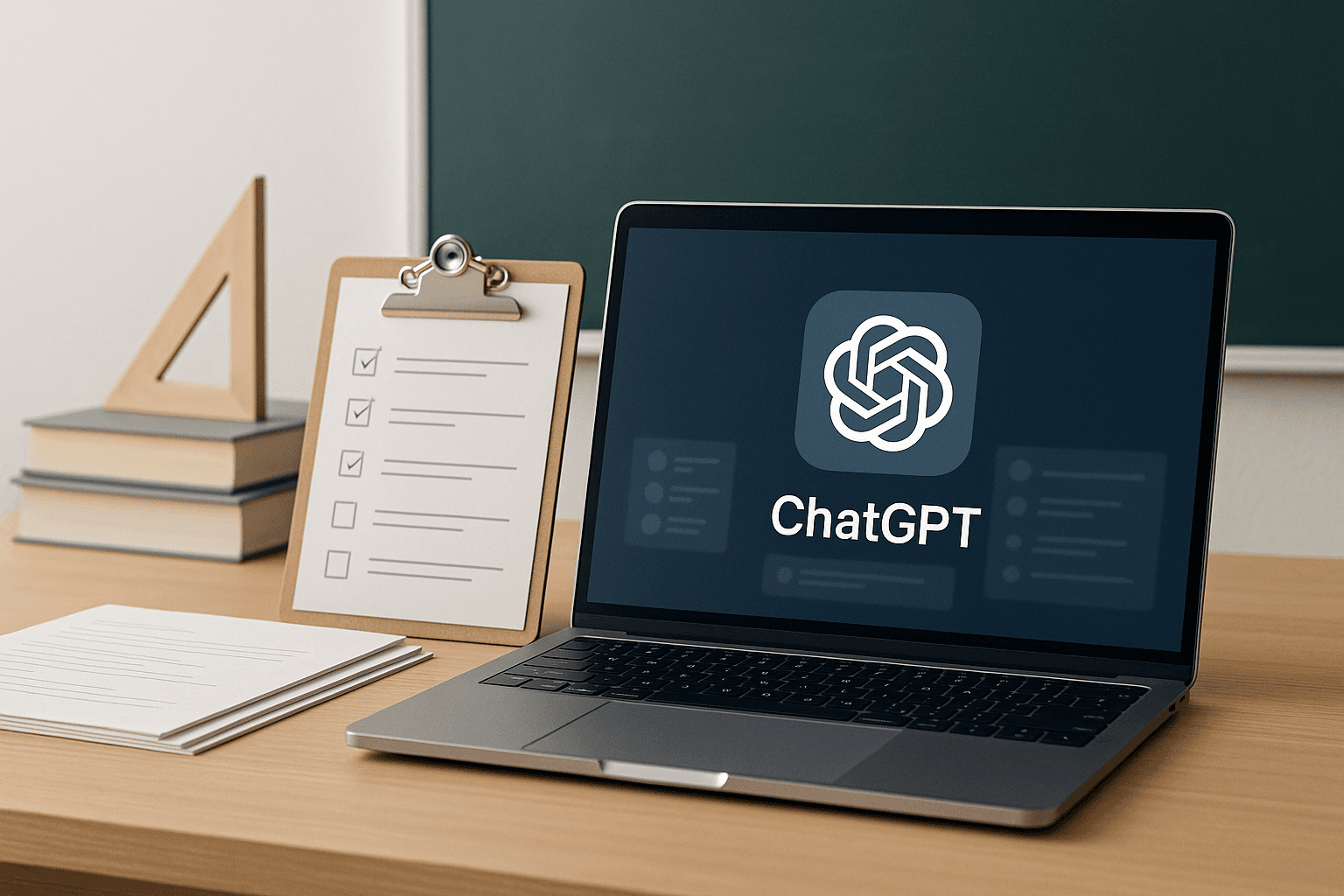
Students are already using ChatGPT and other AI tools. The question is no longer whether AI will enter education. It already has. The better question is how parents and teachers can guide students so AI supports learning instead of replacing effort.
A total ban may feel simple, but it often pushes usage underground. Uncontrolled use is also risky because students may copy answers, avoid thinking, or trust wrong information. The responsible path is guided use with clear boundaries.
This guide gives parents and teachers a practical framework. Schools looking for structured implementation should review Prompt to Profit for Schools.
When ChatGPT can help students
ChatGPT can support learning when it is used to explain, question, organize, and review.
Helpful uses include:
- explaining difficult concepts in simpler language
- creating practice questions
- giving feedback on drafts
- summarizing notes
- helping plan study schedules
- turning rough ideas into outlines
- showing examples
- asking quiz questions
- helping students understand mistakes
The key is that the student remains mentally active.
When ChatGPT harms learning
ChatGPT becomes harmful when it replaces thinking.
Risky uses include:
- submitting AI-written work as personal work
- asking for direct homework answers
- copying essays without understanding
- using AI to avoid reading
- trusting false information
- letting AI solve every problem immediately
- hiding AI use from teachers or parents
The problem is not the tool alone. The problem is unmanaged use.
Teach students the difference between help and cheating
Students need clear examples.
Helpful:
"Explain this topic to me with examples."
Not helpful:
"Write my assignment for me."
Helpful:
"Quiz me on this chapter one question at a time."
Not helpful:
"Give me all the answers."
Helpful:
"Review my draft and tell me what is unclear."
Not helpful:
"Rewrite this so the teacher cannot tell AI helped."
Rules must be specific. Vague statements like "do not misuse AI" are not enough.
Parents should focus on process
Parents should ask how the child used AI, not only whether they used it.
Ask:
- What did you ask the AI?
- What did you already understand before using it?
- What did it explain well?
- What did you check?
- What did you change in your own words?
- Can you explain the answer without looking?
If a student cannot explain the work, they have not learned it.
Teachers should design better assignments
AI exposes weak assignment design. If an assignment can be completed by pasting the question into ChatGPT, it may need redesign.
Better assignments ask students to:
- explain their reasoning
- connect work to class discussion
- show drafts
- present orally
- reflect on mistakes
- compare AI output with their own analysis
- use local or personal context
- submit process notes
Prompt for teachers:
"Redesign this assignment so students can use AI for support but still need to demonstrate understanding, reasoning, and original judgement: [assignment]."
Create AI use rules at home and school
Rules should cover:
- allowed uses
- banned uses
- citation or disclosure expectations
- privacy
- fact-checking
- age-appropriate supervision
- consequences for misuse
- examples of acceptable prompts
Schools should not leave every teacher to create separate rules. A shared policy prevents confusion.
For a deeper school framework, read AI Policy for Schools: What Should Be Included?.
Teach verification
Students must learn that AI can be wrong. This is one of the most important AI literacy skills.
Teach students to check:
- dates
- statistics
- quotes
- historical claims
- scientific explanations
- calculations
- source names
- instructions that could cause harm
Prompt:
"List the claims in this answer that I should verify before using them."
This builds critical thinking.
Use AI for practice, not shortcuts
One of the best student uses is practice.
Prompts:
"Quiz me on this topic one question at a time. Wait for my answer before explaining."
"Give me three practice problems similar to this one, but do not solve them until I try."
"Explain why my answer is wrong without giving me the full answer immediately."
This turns AI into a tutor instead of a cheating machine.
Where structured learning fits
Students need guided AI literacy, not random exposure. Practical programs should teach prompting, verification, project work, safety, and presentation.
Prompt to Profit for Schools is built around practical AI use in a school context. For individual learners outside school, Prompt to Profit provides the broader beginner path.
FAQ
Should students be banned from ChatGPT?
A blanket ban is difficult to enforce. Clear rules and guided use are usually more practical.
Can ChatGPT help students learn?
Yes, when used for explanation, practice, feedback, and revision.
How can teachers detect misuse?
Focus on process, oral explanation, drafts, and reasoning rather than only final text.
What should parents do first?
Discuss acceptable use and ask children to explain how they used AI.
Create age-appropriate rules
The right AI rules for a 10-year-old are not the same as the rules for a university student. Parents and schools should adjust expectations by age and maturity.
For younger learners, AI use should be supervised and focused on explanation, vocabulary, and guided practice.
For teenagers, AI use can include planning, research support, project feedback, and portfolio work, but disclosure and verification should be required.
For older students, AI can support deeper research, writing feedback, coding help, and career preparation, but academic integrity rules must be explicit.
Prompt for parents:
"Create age-appropriate AI use rules for a child aged [age]. Include allowed uses, banned uses, supervision level, privacy rules, and examples of good prompts."
Teach students to show their process
The easiest way to reduce misuse is to make process visible.
Students can submit:
- first outline
- prompt log
- notes before AI use
- AI feedback received
- what they accepted or rejected
- final reflection
- sources checked
This does two things. It discourages copying and helps students become more aware of their thinking.
Teacher prompt:
"Create a student AI process log for this assignment. It should help students disclose AI use, explain decisions, and show what they learned: [assignment]."
Use AI for feedback before final submission
Feedback is one of the best educational uses of AI.
Students can ask:
"Review my draft. Do not rewrite it. Tell me what is unclear, where I need stronger examples, and what questions a teacher may ask."
This keeps ownership with the student. The AI becomes a reviewer, not the author.
Teachers can also teach students to compare AI feedback with peer or teacher feedback. This builds judgement.
Parents should watch for dependency
A student can become too dependent on AI if they use it before trying. Parents should encourage the "try first, ask second" rule.
Practical rule:
- try the task yourself
- write what you understand
- ask AI for help with the stuck point
- explain the answer back in your own words
- complete the work yourself
If the child cannot explain the result, the AI has done too much.
What schools should communicate clearly
Schools should not leave parents guessing.
A good parent communication should say:
- the school's position on AI
- examples of acceptable use
- examples of cheating
- privacy rules
- how assignments may change
- how parents can support responsible use
- who to contact with concerns
This builds trust and reduces confusion.
Practical classroom activity
One useful activity is the AI critique exercise.
The teacher gives students a topic and asks AI for an answer. Students then evaluate the answer:
- What is correct?
- What is vague?
- What is missing?
- What needs evidence?
- What would you improve?
This teaches students that AI output is not automatically final.
Continue reading
Related lessons for this topic

How Teachers Can Use AI to Save Time Without Losing Quality
A practical guide for teachers using AI to plan lessons, create examples, differentiate explanations, draft feedback, and reduce admin without weakening learning.
Read next
Holiday AI Programs for Children in Nigeria: What Parents Should Look For
A practical guide for Nigerian parents choosing a holiday AI program that helps children build real projects instead of only watching videos.
Read next
AI Safety for Children in Nigeria: Rules Every Parent Should Teach
Simple AI safety rules Nigerian parents can teach children before they use ChatGPT, AI website builders, or other online learning tools.
Read next