
The Future of Homework in the Age of AI will not be decided by whether schools can stop students from using technology at home. They cannot reliably control every device, app, sibling, tutor or chatbot available after school hours. The more useful question is this: what kind of homework still provides trustworthy evidence that a student is learning?
For decades, teachers often treated the completed product as evidence of understanding. A neat essay suggested writing ability. Correct calculations suggested mathematical competence. A polished presentation suggested research skill. Generative AI has weakened that assumption because a student can now produce an impressive-looking answer without making the decisions behind it.
Homework is not finished. But assignments that reward only the final answer are becoming less useful. The future belongs to homework that makes thinking visible, sets clear boundaries for assistance and gives students a chance to explain what they submitted.
Homework needs a new job description
Good homework should extend learning beyond the classroom, not merely generate more pages for teachers to mark. Depending on the lesson, it may help students practise a skill, retrieve knowledge, observe something in their environment, prepare for discussion or apply a concept independently.
Those purposes remain valid in an AI-enabled world. What must change is the evidence collected. A teacher should no longer ask only, “What did the student submit?” The teacher should also ask:
- What decisions did the student make?
- What can the student explain without assistance?
- Can the student apply the same idea to a slightly different problem?
- Was any outside help disclosed?
- Did the assignment require genuine observation, judgement or experience?
This shift also treats AI literacy as part of education rather than as an inconvenience. The UNESCO AI Competency Framework for Students connects responsible use with human judgement, ethics, practical application and creation. Homework can develop these abilities, but only when the task requires students to evaluate AI output rather than quietly submit it.
Put every assignment in one of three lanes
Confusion encourages dishonest use. “Do not cheat” is not a complete AI policy because students may not know whether brainstorming, translation, grammar correction or asking for an explanation counts as cheating. Every homework brief should therefore identify one of three lanes.
Lane 1: Independent practice
No AI assistance is allowed. This lane is appropriate when the teacher needs to see what the student can currently do alone: recalling vocabulary, solving equations, writing a short paragraph, drawing a labelled diagram or preparing for a timed assessment.
The reason should be stated plainly: “Complete this without AI because I need to see which parts you can already do independently.” A short task with a clear learning purpose is more defensible than banning AI from a long project that students are expected to complete unsupervised.
Lane 2: Guided assistance
AI may support selected stages, but it may not produce the final submission. A student might use it to generate practice questions, explain an unfamiliar term, suggest counterarguments or identify weaknesses in a draft. The student must then verify, revise and disclose that help.
For example, an SS2 student writing about waste disposal in the local community could develop an initial outline personally, ask an AI tool to challenge the argument, and then decide which criticism is valid. The submitted work would include the original outline, the useful suggestion and a sentence explaining why other suggestions were rejected.
Lane 3: AI is part of the task
Here, students are expected to use AI because evaluating the tool is one of the learning outcomes. They might compare two generated explanations, locate unsupported claims, improve a weak prompt or rewrite an answer for a different audience.
This lane should not become a competition to see who has the most expensive subscription or fastest internet connection. Schools must provide an equivalent route, shared access or a non-AI alternative when students cannot access the selected tool.
Build a five-part proof-of-learning chain
A strong homework system does not depend on catching students after something goes wrong. It collects several small pieces of evidence that connect the learner to the work.
- First attempt: Ask for an outline, rough calculation, prediction, sketch or short response before assistance is used.
- Help log: Students record whether they consulted a person, textbook, website or AI tool and what help they received.
- Final response: They submit the improved work in the normal format.
- Explanation: They identify one important decision, correction or difficulty in their own words.
- Transfer check: The teacher gives a related question in class, requests a short oral explanation or changes one condition in the original problem.
Not every assignment needs a formal interview. A teacher with a large class can select a few students each week, use two-minute peer explanations, ask everyone to answer an exit question or conduct brief group demonstrations. The objective is not surveillance. It is to make explanation a normal part of submitting work.
Redesign tasks instead of merely making them longer
Adding more questions does not make homework resistant to outsourcing. Better tasks combine subject knowledge with evidence that is difficult to manufacture convincingly.
English and literature
Instead of “Write 800 words about the main character,” ask students to select one decision made by the character, defend or criticise it using two passages, and record a 90-second explanation. If AI is permitted, require students to identify one generated interpretation they rejected and explain why the text did not support it.
Mathematics
Use short independent exercises for fluency, followed by an error-analysis task. Present an incorrect solution and ask students to identify the first wrong step, correct it and explain the underlying rule. AI may be used in a guided lane to generate alternative explanations, but the student must choose which explanation is clearest and test it on a new problem.
Science
Connect homework to observation. A student might predict what will happen, conduct a safe household investigation, keep dated notes and compare the result with the prediction. AI can help organise the report if allowed, but it must not invent measurements or observations. A brief classroom question about an unexpected result will reveal more than a perfectly formatted report.
Civic education, history and social studies
Ask students to compare a generated answer with class notes, a textbook or teacher-approved sources. Their task is to mark claims as supported, unsupported or uncertain. This teaches verification while showing that fluent language is not the same as reliable evidence.
Grade understanding more heavily than polish
Rubrics must match the new design. If most marks still go to grammar, formatting and presentation, students will naturally optimise the polished product. An illustrative 100-mark structure might award:
- 40 marks for subject understanding and accuracy;
- 25 marks for reasoning, evidence or application;
- 20 marks for process work and revisions;
- 10 marks for explanation or transfer;
- 5 marks for honest disclosure and source handling, where applicable.
The exact percentages should change by subject and age. The principle is more important: marks should reward the learning decisions that the teacher actually wants to develop.
Schools should also avoid treating an automated detector score as a verdict. If work appears inconsistent with a student’s established ability, the teacher can review drafts, ask neutral questions and provide a short follow-up task. A conversation produces more useful evidence than an accusation based on one signal.
Protect privacy and preserve fair access
Students should not paste their full names, classmates’ details, assessment records, family information, unpublished school documents or sensitive photographs into public AI systems. Schools should review the tools they recommend, communicate what data may be collected and provide age-appropriate supervision. UNESCO’s guidance on generative AI in education and research specifically emphasises data privacy, age-appropriate use and human-centred decisions.
Access is equally important in Nigeria, where students in the same class may have very different devices, data budgets, electricity supply and connectivity. AI-dependent homework should not assume continuous internet access. A fair plan can include printed materials, school-based access periods, work completed in pairs or an equivalent offline task.
Teachers and school leaders who need a broader implementation conversation can explore the Academy’s AI for Schools support. Practical planning materials can also be added gradually through the resource library rather than introducing a complicated policy that staff and families cannot apply consistently.
A practical homework brief teachers can reuse
Before assigning work, complete these six lines:
- Learning target: What should the student know or be able to do?
- AI lane: Is the task independent, guided or AI-required?
- Allowed help: Which people, materials and tools may be consulted?
- Required evidence: What rough work, notes, sources or observations must accompany the answer?
- Verification: How will the student explain or transfer the learning?
- Access alternative: What can a student do if the required technology is unavailable?
If a teacher cannot answer these questions, the assignment is probably not ready. This brief also gives parents a clearer role. They can ask the child to explain the instructions, discuss ideas, provide materials or check that the work was completed. They should not become substitute writers or prompt operators.
The future is visible thinking, not perfect output
The strongest response to AI is not to eliminate homework or pretend that every take-home answer is independent. It is to redesign homework so that assistance is declared, reasoning is documented and understanding can be demonstrated again.
Students will use AI in further education, employment and everyday life. Schools therefore have two responsibilities: preserve the independent practice needed to build real competence, and teach students how to use powerful tools without surrendering judgement. Homework can serve both purposes when the task values process, explanation, verification and human responsibility more than a polished page.
Continue reading
Related lessons for this topic
How to Teach Prompting to Students Responsibly
A practical guide for teaching students prompt writing, context, examples, verification, disclosure, project work, and responsible AI behaviour.
Read nextDigital Skills Students Should Learn Before Leaving School
A practical guide to the digital skills students should learn before leaving school, including AI literacy, research, communication, safety, building, and portfolio work.
Read next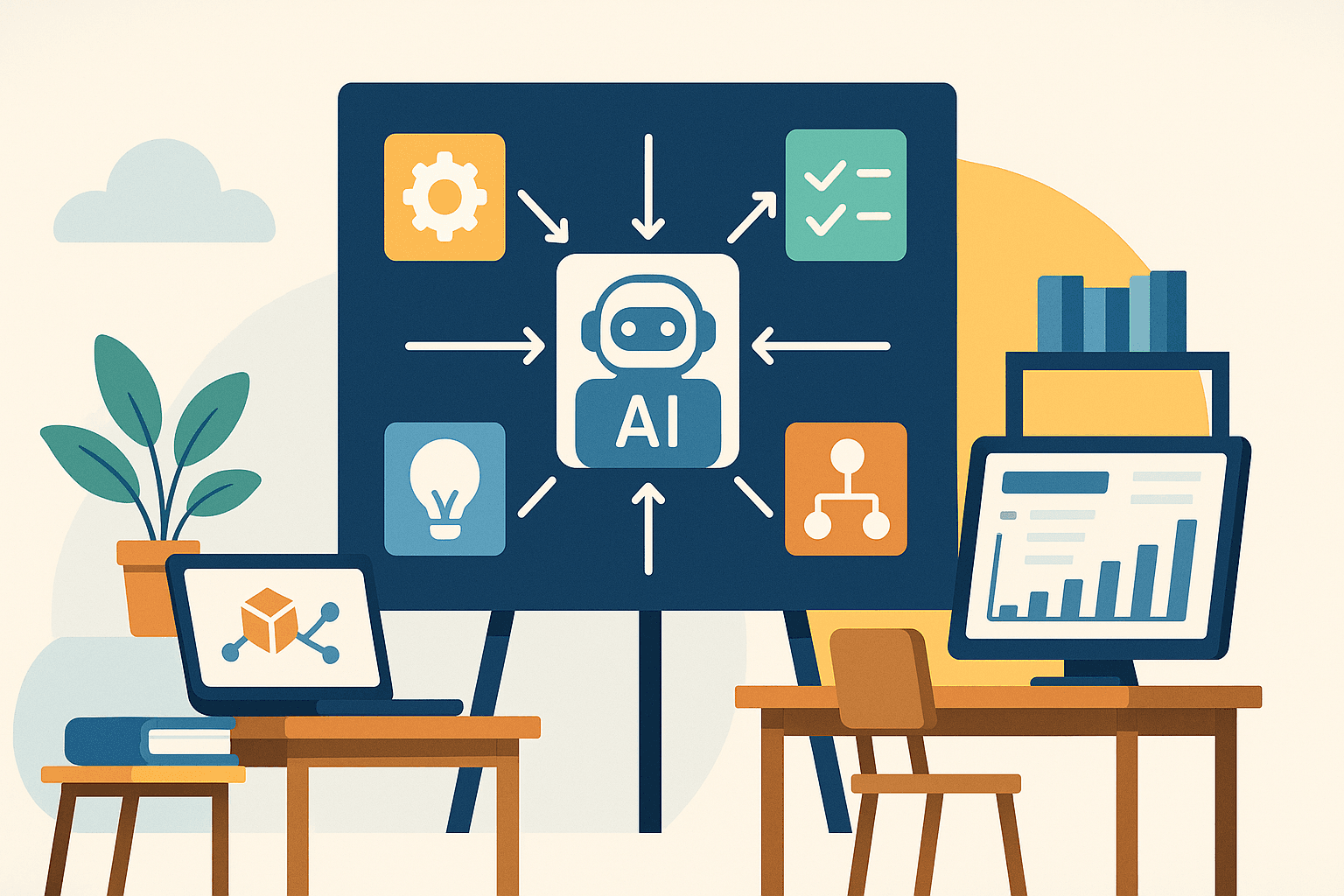
AI Club Ideas for Schools
Practical AI club ideas for schools, including projects, weekly activities, safety rules, student roles, showcase events, and responsible AI habits.
Read next