
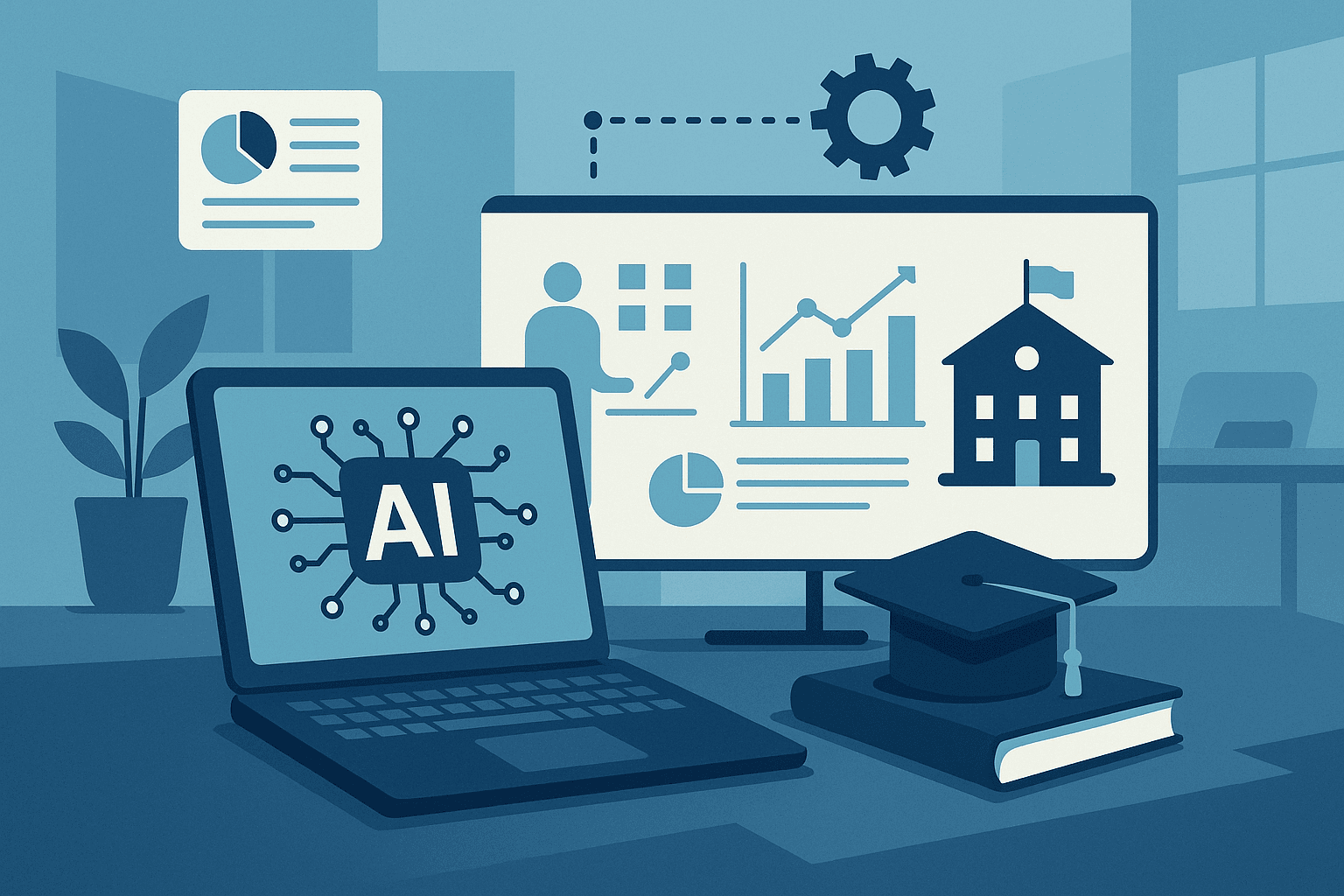
AI in Education courses are becoming important because schools cannot ignore AI. Students are using AI. Teachers are hearing about AI. Parents are asking questions. School owners are wondering whether AI can improve learning, administration, admissions, and teacher productivity. The challenge is no longer whether AI will enter education. It already has. The challenge is how to use AI responsibly.
If you are a teacher, school owner, administrator, parent, or education leader in Nigeria, you need AI in Education courses that go beyond excitement. A serious Artificial Intelligence course for education should help you understand AI, use AI practically, protect students, guide teachers, and create policies that make sense.
Why AI in Education courses matter
Education is sensitive. A poor AI course can encourage shortcuts, plagiarism, privacy mistakes, and careless teaching. A good AI in Education course helps schools use AI as support, not replacement. AI can assist teachers, but teachers still carry professional judgment. AI can support students, but students still need thinking, practice, and accountability.
AI in Education courses matter because they help schools move from fear or hype to responsible adoption. Teachers need confidence. Students need guidance. Parents need reassurance. School leaders need policy. Everyone needs clarity.
What teachers should learn in an AI course
How AI can support lesson planning without replacing teacher judgment.
How to create examples, activities, quizzes, and revision materials with AI.
How to adapt explanations for struggling learners and advanced learners.
How to use AI for feedback while protecting student privacy.
How to check AI-generated answers before using them in class.
How to teach students ethical and responsible AI use.
A teacher-focused AI course should be practical. Teachers should leave with lesson planning prompts, feedback prompts, assessment prompts, parent communication prompts, and classroom rules they can actually use.
What school owners should learn
School owners and administrators need a wider view. AI in Education courses for school leaders should include policy, staff training, parent communication, data privacy, approved tools, student rules, and implementation planning.
A school should not introduce AI by simply telling teachers to use ChatGPT. That creates confusion. A better approach is to define what AI can be used for, what data must not be entered, how outputs should be checked, and how students will be guided.
AI for lesson planning
One of the most immediate uses of AI in education is lesson planning. A teacher can ask AI to create a lesson outline, examples, starter questions, class activities, revision questions, and homework. But the teacher must provide context: class level, subject, topic, time available, syllabus requirement, students' current understanding, and available materials.
AI can make lesson preparation faster, but it should not make the lesson generic. If the AI output sounds like it could be used in any country, any school, and any class, the teacher should improve the prompt. Nigerian classrooms need local examples, realistic timing, and practical teaching conditions.
AI for student support
AI can help students revise, practice questions, understand difficult concepts, and receive explanations. But students must learn how to use AI honestly. AI should not become a tool for submitting work they cannot explain. AI should help them learn, question, practice, and improve.
AI in Education courses should teach schools how to guide students. For example, students can ask AI to explain a topic, create practice questions, mark their attempt, and show where they went wrong. That is better than asking AI to do the assignment from start to finish.
Privacy and safety in school AI use
Privacy is one of the most important parts of AI in Education courses. Teachers and staff should not paste student records, private family information, medical details, disciplinary notes, full names, addresses, passwords, or sensitive school data into AI tools.
Schools should create simple rules. What tools are approved? What information is prohibited? Who reviews AI output? How should teachers use AI for lesson planning? What are students allowed to do? What happens when AI is used wrongly? These questions should be answered before AI becomes widespread in the school.
AI in Education courses for parents
Parents also need AI education. Many parents are worried that AI will make children lazy. That concern is understandable. The answer is not to pretend AI does not exist. The answer is to teach children safe, supervised, age-appropriate, and honest AI use.
A good AI course for parents should explain how AI can support revision, creativity, reading, writing, and project work while also showing what children should not do. Children should not share private information with AI tools, and they should not submit work they cannot explain.
How schools can start responsibly
Start with teacher productivity before student-facing AI tools.
Create a simple AI use policy for staff and students.
Train teachers with practical classroom examples.
Communicate clearly with parents.
Pilot AI use in a few safe workflows before expanding.
Review what works and what creates risk.
AI in Education courses should help schools implement AI in stages. The goal is not to look modern. The goal is to improve teaching, learning, communication, and administration without compromising safety.
AI in education should begin with teacher support
When schools think about AI, many people immediately think about students using AI. That is important, but it should not be the first step. The safer first step is teacher support. AI in Education courses should help teachers prepare better lessons, create clearer examples, design revision materials, generate practice questions, and support different learner levels.
Teachers are already under pressure. They prepare lessons, mark work, respond to parents, manage classrooms, support weak learners, and still try to keep students engaged. AI can reduce some of that burden if it is used responsibly. A teacher can ask AI for a lesson outline, but the teacher must still adjust it to the class. A teacher can ask AI for questions, but the teacher must still check the answers. A teacher can ask AI for feedback language, but the teacher must still know the student.
This is why AI in Education courses should respect teachers. AI should not be presented as a replacement for teaching skill. It should be presented as a support system that helps teachers prepare, reflect, and improve.
AI policy for Nigerian schools
Every school that wants to introduce AI should have a simple AI policy. The policy does not need to be long or full of legal language. It needs to be clear enough for teachers, students, parents, and administrators to understand. AI in Education courses should help school leaders create this kind of practical policy.
A school AI policy should explain which AI tools are approved, what teachers may use AI for, what students may use AI for, what information must never be entered into AI tools, how AI-assisted assignments should be declared, and how teachers should review AI-generated material. It should also explain consequences for misuse and the process for updating the policy as AI tools change.
For Nigerian schools, parent communication is especially important. Parents should understand that the school is not encouraging laziness or cheating. The school is teaching responsible AI use. That message must be clear. If parents only hear that students are using AI, some will worry. If they hear that the school has rules, supervision, privacy safeguards, and learning goals, trust becomes easier. This is especially true for parents who already worry about screen time, exam integrity, and online safety.
AI for assessment and academic integrity
Assessment is one of the most sensitive parts of AI in education. Students can use AI to generate essays, solve assignments, and produce work that looks polished. Schools cannot respond by pretending AI does not exist. They need better assessment design.
AI in Education courses should teach teachers how to design assignments that require process, reflection, oral explanation, drafts, classroom participation, and personal application. If students submit a project, they should be able to explain what they did, what AI helped with, what they changed, and what they learned. This makes cheating harder and learning more visible.
Teachers can also use AI to create rubrics, but they should review the rubric carefully. AI can suggest criteria, but the teacher must decide what matters. Good assessment still depends on human judgment.
AI for school administration
AI in Education courses should not focus only on classrooms. Schools also have administrative work. AI can help with newsletters, admissions follow-up, staff memos, parent notices, meeting summaries, policy drafts, event planning, timetable communication, and internal documentation.
For school owners, this can save time and improve communication. A school can use AI to draft a polite fee reminder, explain a new policy, summarize meeting notes, or prepare a parent update. However, staff must avoid pasting private student records, payment details, family issues, or sensitive complaints into public AI tools.
Good AI adoption in a school often starts with these low-risk administrative workflows. Once staff become comfortable with responsible AI use, the school can expand carefully into teaching and student support.
AI for students with safety and supervision
Students should learn how to use AI, but they need guidance. AI can help students understand difficult topics, practice questions, summarize notes, and review mistakes. But AI can also make students dependent if they use it to avoid thinking. AI in Education courses should help teachers and parents guide students toward learning, not shortcuts.
A useful rule is this: students should use AI to explain, question, quiz, review, and improve their own attempt. They should not use AI to replace their attempt. When students use AI this way, it can strengthen learning. When they use AI to submit work they cannot explain, it weakens learning.
For children, supervision matters even more. Children should not share personal details, school passwords, family information, addresses, or private images with AI tools. AI safety should be part of every school AI conversation.
What success should look like for AI in a school
Success with AI in education should not be measured by how many tools a school mentions on its website. Success should be measured by better teaching preparation, clearer student support, stronger parent communication, safer policy, and more confident teachers. If AI helps a teacher prepare targeted revision questions faster, that is useful. If AI helps a school communicate a policy clearly to parents, that is useful. If AI helps students review mistakes without replacing their own effort, that is useful. If AI creates confusion, privacy risk, or lazy learning habits, the school needs to slow down and redesign the approach.
AI in Education courses should therefore help schools define outcomes before choosing tools. The question should not be “Which AI tool is trending?” The question should be “What education problem are we solving, and how can AI support that work responsibly?”
Bring practical AI education to your school
Explore AI programmes designed for schools, teachers, students, and responsible education leaders.
This article is part of our AI learning guide series. You may also want to read our guides on AI certification course in Nigeria, AI training course in Nigeria, AI in Education courses in Nigeria, and the best AI course for beginners in Nigeria.
Frequently Asked Questions
What are AI in Education courses?
AI in Education courses teach teachers, schools, parents, and education leaders how to use AI for teaching, learning, administration, student support, and policy in a responsible way.
Can AI replace teachers?
No. AI can support teachers with planning, examples, feedback, and revision materials, but teacher judgment, care, classroom awareness, and professional responsibility remain essential.
Should schools allow students to use AI?
Schools should not ignore AI. They should create rules for responsible use, teach students how to use AI honestly, and protect student privacy.
Continue reading
Related lessons for this topic
Artificial Intelligence Course in Nigeria: A Practical Guide for Beginners, Students, Teachers, and Business Owners
A practical Nigerian guide to choosing an Artificial Intelligence course that teaches real AI skills, useful projects, and confident execution.
Read next
AI Certification Course in Nigeria: What to Look For Before You Enrol
A practical guide to choosing an AI certification course that gives you more than a certificate: real AI skills, proof of work, and credibility.
Read next
How Nigerian Schools Can Launch an AI Program Without Overwhelming Teachers
A practical rollout plan for Nigerian school owners who want AI education without adding confusion, workload, or technical stress for teachers.
Read next