
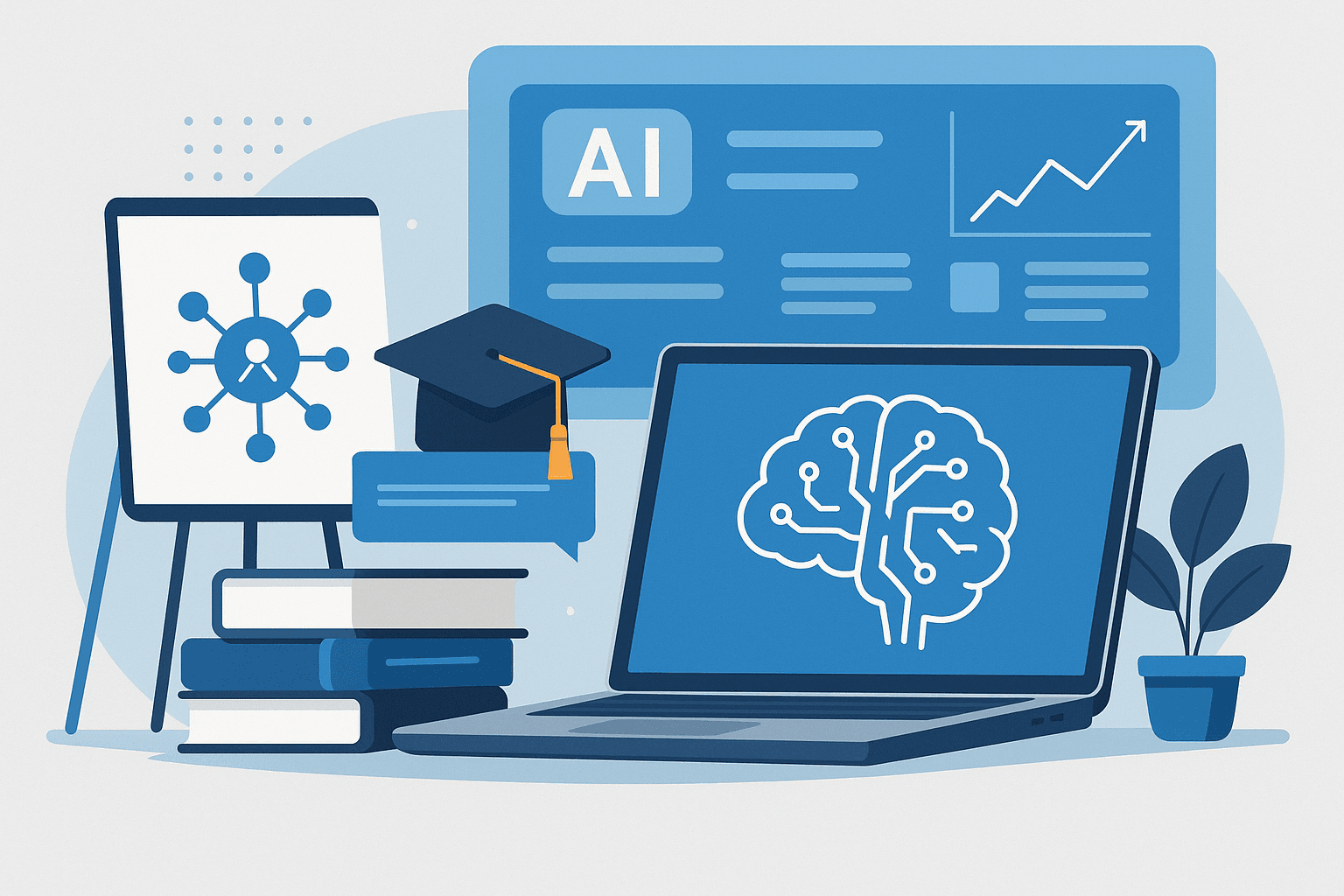
Quick summary: Strong AI courses in Nigeria should give you practical AI literacy, better prompting and evaluation skills, role-relevant applications, completed projects, responsible-use habits, and enough feedback or support to improve your work. The goal is not to memorise tool names or believe exaggerated promises. It is to use AI confidently, verify its output, and produce useful evidence of what you can do.
If you want hands-on, project-oriented training, explore Prompt to Profit as a practical next step. It is intended for learners who want to turn foundational AI knowledge into useful outputs, services, workflows, or portfolio projects.
AI courses in Nigeria: what practical training should deliver
When people search for an artificial intelligence course in Nigeria, they are often looking for more than definitions. A student may want study support and a stronger portfolio. A teacher may want help preparing lessons without weakening academic integrity. A business owner may want faster customer replies and clearer operating procedures. A non-technical founder may want to test a digital product idea.
A good course connects AI to these real outcomes. It should explain what AI can and cannot do, teach you how to give useful instructions, help you evaluate responses, and require you to apply the learning. It should also make clear that AI can produce inaccurate, incomplete, biased, or unsuitable output. Human judgment remains necessary.
Be cautious when a course promises instant mastery, guaranteed employment, government endorsement, or universally recognised certification. A credible course should state its scope, learning outcomes, project requirements, support model, and method for confirming completion without exaggerating what the certificate represents.
A quick map of AI course types in Nigeria
There is no single format that suits every learner. Before comparing courses, identify the kind of learning environment that matches your goal, schedule, access to devices, and need for support.
- University modules
These may introduce AI through computer science, data science, engineering, business, education, or another discipline. They can provide academic structure, but the amount of practical generative AI work will depend on the curriculum.
- Short workshops
Workshops are useful for focused introductions, team awareness, or a specific task. Check whether participants practise during the session and leave with reusable materials rather than only watching demonstrations.
- Online cohorts
Cohort courses usually combine scheduled lessons, assignments, peer learning, and facilitator feedback. They can suit learners who need deadlines and accountability.
- Self-paced micro-courses
These focus on a narrow skill and allow flexible study. They work best for disciplined learners, especially when they include exercises, model answers, or a way to request feedback.
- Corporate and team training
This format should connect AI use to actual roles, documents, approval processes, data risks, and business objectives. Generic tool demonstrations are less useful than supervised work on realistic scenarios.
- Teacher professional development
Training for educators should cover teaching practice, assessment, student use, privacy, school procedures, and communication with parents or guardians. It should not treat classroom AI adoption as only a software lesson.
How to choose an AI course in Nigeria
Start with the outcome you want. Then use the following checklist to assess whether the course can realistically help you reach it.
Clear outcomes: The course should explain what you will understand, practise, and build. “Learn many AI tools” is less useful than a defined outcome such as creating a verified research workflow or customer-reply system.
Relevant local examples: Look for scenarios connected to Nigerian schools, NYSC and entry-level career preparation, small businesses, professional services, mobile-first work, and customer conversations across channels such as email, WhatsApp, or social media.
Required projects: Confirm that you will produce something substantial enough to review, improve, and demonstrate. A course should not confuse watching lessons with developing competence.
Feedback loops: Ask how assignments are reviewed. Useful feedback may come from a facilitator, structured peer review, live critique, or detailed assessment criteria.
Time to first result: Find out how soon you will complete a small, useful task. Early practice helps you test the teaching method before moving to more complex work.
Responsible-use training: The curriculum should address privacy, verification, plagiarism, attribution, bias, security, and situations where AI should not make the final decision.
Completion requirements: Check whether completion depends on attendance, assessments, project submission, or another stated standard.
Verification: If a certificate matters to you, ask how another person can confirm it. Verification may involve a certificate page, reference, provider record, or other documented process. Do not assume that verification equals accreditation or automatic recognition.
Accessible delivery: Consider lesson recordings, transcripts, captions, mobile access, downloadable materials, data requirements, and what happens if your connection fails during a live class.
Realistic claims: Avoid courses that guarantee jobs, income, mastery, or business results. Training can improve capability, but outcomes still depend on practice, judgment, context, and execution.
Use the Resource Library for practical guides, templates, and checklists that can help you plan your learning and document course projects.
A practical AI syllabus should have four layers
1. AI literacy and essential terms
The first layer should explain artificial intelligence, generative AI, machine learning, large language models, prompts, context, tokens, hallucinations, automation, and human review in beginner-friendly language. Learners should understand that an AI response can sound confident without being accurate.
This layer should also distinguish between using an existing AI tool, connecting tools into a workflow, and developing an AI system. That distinction prevents beginners from assuming that every AI-related task requires advanced mathematics or software engineering.
2. Prompting, evaluation, and iteration
Prompting is more than typing a question. A useful prompt often includes the task, background, audience, constraints, source material, desired format, examples, and review criteria. Learners should practise turning vague requests into clear instructions.
Prompting must be taught alongside evaluation. A course should show you how to inspect an answer, test assumptions, request alternatives, compare versions, check calculations, review sources, and decide whether the output is suitable for its intended audience. The process is usually iterative: instruct, inspect, correct, test, and refine.
3. Real applications by role
The third layer should connect AI to real responsibilities. Students need different examples from teachers. A retailer needs different workflows from a lawyer, administrator, analyst, or software builder. Role-based exercises help learners transfer a general skill into their own environment.
4. Projects and portfolio evidence
A project turns a lesson into evidence. It should begin with a defined problem, include drafts and testing, and end with a usable result plus a short explanation of the learner's decisions. Where appropriate, the learner should retain prompt versions, evaluation notes, source records, and before-and-after examples.
A project does not need to be large to be credible. A carefully tested lesson-planning pack, prompt library, customer-service workflow, research assistant, or simple internal tool can demonstrate more judgment than a collection of unreviewed AI outputs.
AI courses for students, graduates, NYSC members, and job seekers
Students can use AI to explain difficult topics, generate practice questions, structure revision, compare viewpoints, improve drafts, and plan projects. Honest use means keeping responsibility for the thinking. Do not submit generated work as your own, invent references, or use AI to bypass an assessment's rules.
For CV improvement, AI can help you identify unclear descriptions, match relevant experience to a role, and turn vague statements into evidence-based bullet points. It should not invent qualifications, employers, responsibilities, achievements, or metrics. Review every line before using it.
Job seekers can also use AI for interview practice. Give the tool a job description and ask it to act as an interviewer, question weak answers, and help you structure examples. An NYSC member preparing for an entry-level operations role, for example, could practise explaining how they organised records, supported a community project, coordinated people, or solved a service problem. The final answer should remain truthful and sound like the candidate.
Useful portfolio evidence may include a documented research workflow, an AI-assisted study system, a small website, a data-cleaning exercise, a communication pack, or a simple tool that solves a clear problem. Explain what you built, what AI helped with, how you tested it, and what you changed after review.
AI training for teachers and schools
Teachers can use AI to draft lesson outlines, create examples at different difficulty levels, prepare revision materials, suggest assessment questions, develop marking criteria, and simplify parent communication. Every output still needs subject knowledge and contextual review. A generated lesson may contain factual errors, unsuitable language, poor sequencing, or examples that do not match the learners.
Differentiated instruction should involve more than asking AI to make work “easier” or “harder.” Teachers can specify the learning objective, age group, prior knowledge, reading level, common misconceptions, available materials, and the support different learners require.
Assessment training should address what students may use AI for, what they must complete independently, how AI assistance should be disclosed, and how teachers can design tasks that require reasoning, discussion, practical work, reflection, or evidence of process. UNESCO's guidance on generative AI in education and research and its AI competency framework for teachers are useful primary references for schools considering human-centred and responsible adoption.
Privacy basics matter whenever teachers handle student names, results, health information, behavioural records, parent messages, photographs, or other personal data. Schools should avoid placing sensitive information into an AI service without an approved purpose, appropriate safeguards, and a clear understanding of how the service handles data. Nigerian institutions can consult the Nigeria Data Protection Commission's official resources and obtain qualified advice where necessary.
School adoption should be planned rather than improvised. Consider staff training, approved use cases, assessment expectations, access and inclusion, parent communication, incident reporting, periodic review, and a small pilot before wider deployment. Schools should check current official guidance that applies to their situation instead of assuming that a general course provides legal or regulatory approval.
Principals, teachers, parents, and school owners can explore AI for Schools for practical training and support focused on education contexts.
AI courses for Nigerian business owners, teams, and professionals
For business owners, the most useful AI training often begins with repeated work. Identify tasks that consume time, follow a recognisable pattern, and can still be checked by a person.
Possible applications include drafting customer replies, organising frequently asked questions, preparing sales follow-ups, outlining proposals, writing product descriptions, creating content plans, summarising meeting notes, documenting standard operating procedures, and turning rough ideas into structured business documents.
In a Nigerian SME context, a retailer could create a reviewed reply library for delivery questions, stock enquiries, payment instructions, returns, and order follow-ups. A service business could prepare proposal templates for different client needs. A small team could turn an experienced employee's voice notes into a draft SOP, then review each step before adoption.
AI can also help interpret a table or report by suggesting patterns and questions to investigate. It should not be trusted to invent missing data or make an important financial, employment, safety, or customer decision without appropriate review. Learners should know how to inspect the original information and reproduce critical calculations independently.
Simple automation may connect a form, spreadsheet, document template, notification, or approval step. A good course should help learners map the process before selecting tools. It should also cover access controls, error handling, testing, and what staff should do when the automation fails.
SMEs and teams that prefer a custom portal, workflow, dashboard, or automation can consider the Build Service instead of trying to assemble a production system without the required capacity.
AI-assisted building for non-technical learners
AI can help a non-technical builder describe a problem, plan a feature, generate starter code, explain unfamiliar code, identify possible errors, and propose tests. This lowers the barrier to experimentation, but it does not remove the need for technical judgment.
Use a stepwise process:
Define one small user problem and the expected result.
Write the workflow in plain language before requesting code.
Ask AI to explain the proposed structure, assumptions, dependencies, and risks.
Build the smallest testable version rather than requesting an entire complex product at once.
Run the code in an appropriate test environment with sample data.
Test normal use, incorrect input, empty input, failed connections, and access restrictions.
Read error messages and correct one issue at a time.
Request human technical review before handling sensitive data, accepting payments, serving many users, or making the tool operationally important.
AI-generated code may contain security weaknesses, outdated approaches, broken dependencies, or logic that appears to work only under limited conditions. Keep backups, protect credentials, avoid exposing real customer data during experiments, and document changes.
If you already understand foundational prompting and want to develop more robust workflows or tools, explore Prompt to Profit Advanced.
Responsible AI use and risk management
A practical AI course should make responsible use part of every lesson rather than treating it as an optional final topic.
Protect privacy: Remove unnecessary personal, confidential, financial, medical, student, employee, and customer information before using AI. Follow your organisation's approved procedures.
Verify important outputs: Check claims against reliable sources, review calculations, test links, and confirm names, quotations, dates, and references.
Avoid plagiarism: Use AI to support understanding and drafting, not to misrepresent generated material as independent work. Follow the relevant school, publication, employer, or client rules.
Use attribution where appropriate: Keep records of sources and disclose material AI assistance when the context requires it.
Keep humans in the loop: A qualified person should review decisions that affect people's rights, safety, education, finances, employment, access, or reputation.
Test for different users: Review whether examples, language, or recommendations unfairly exclude or disadvantage a group.
Plan for failure: Decide how errors will be detected, reported, corrected, and prevented from spreading through a workflow.
Teams that need a structured reference can review the NIST AI Risk Management Framework, a voluntary framework for considering and managing AI risks across different use cases.
What to build during an AI course
Choose a project connected to a real audience and a problem you understand. The following menu can help you define a manageable course outcome.
For students and job seekers
A study prompt library with verification and citation steps.
An interview-practice system based on a real job description.
A truthful CV-improvement workflow with a checklist against invented claims.
A portfolio website explaining one project, its testing process, and lessons learned.
For teachers and schools
A lesson-plan pack for one topic, including differentiated activities and teacher review notes.
An assessment-redesign guide that states acceptable and unacceptable AI assistance.
A parent communication pack explaining a proposed classroom AI pilot.
A staff prompt library that excludes personal student information.
For business owners and professionals
A reviewed customer-service reply system for common enquiries.
An SOP pack created from interviews or voice notes and verified by process owners.
A sales-message library for different customer needs and stages.
A content-planning workflow that moves from customer questions to reviewed drafts.
For non-technical builders
A simple internal tool for collecting and organising requests.
A prototype that turns structured form input into a draft document for human approval.
A small dashboard using sample or appropriately protected data.
A workflow that connects an intake form, review step, and notification.
If you need one-to-one help scoping, building, testing, or improving a project, consider Private AI Build Coaching.
Practical expectations before you enrol
Prerequisites depend on the outcome. You do not need coding for a general AI literacy or workplace productivity course. You may need basic spreadsheet, browser, file-management, or writing skills. If you want to build software or automations, be prepared to learn basic technical concepts and test generated work carefully.
Learning time depends on scope and practice. A focused course may help you complete an initial task early, but no honest timetable guarantees mastery. Look for milestones such as the first reviewed prompt, first role-based workflow, first project draft, testing, and final presentation.
Certification should be interpreted realistically. A course certificate can document completion under the provider's stated requirements. It does not automatically prove professional competence, accreditation, government endorsement, job readiness, or universal recognition. A certificate becomes more persuasive when it is supported by a completed project and a clear explanation of your contribution.
Schools should adopt AI in stages. A training session alone is not an adoption strategy. School leaders should identify an educational purpose, train staff, define acceptable use, consider privacy and assessment, communicate with parents, pilot the approach, collect feedback, and review the decision before expanding it.
The Nigerian context should shape the learning experience
A useful AI course in Nigeria should be designed for realistic learning and working conditions. Learners may switch between phones and laptops, attend around work or school responsibilities, or need materials that remain useful when a live connection is interrupted. Course design should account for these possibilities without reducing the quality of the learning.
Examples should also feel relevant. A trader improving customer replies, an NYSC member preparing for an entry role, a teacher managing several ability levels, a professional drafting reports, and a founder testing a service idea need different exercises. AI is global, but practical instruction becomes clearer when learners recognise the problem being solved.
Local relevance does not mean ignoring global standards. Strong AI courses in Nigeria should combine Nigerian examples with transferable skills: clear communication, evidence checking, privacy awareness, ethical judgment, process design, testing, documentation, and continuous improvement.
Take the next practical step
Choose an AI course by the quality of its outcomes, practice, feedback, projects, and responsible-use training—not by the number of tools in its sales page. Write down one problem you want AI to help you solve, identify the project that would prove progress, and confirm that the course gives you a credible path from instruction to reviewed work.
If you want hands-on training focused on useful outputs and project execution, start with Prompt to Profit. The aim is to help you move from curiosity and scattered experimentation to a more deliberate, practical way of using AI.
Frequently Asked Questions
Which AI course is best in Nigeria?
There is no single “best” course for everyone. Choose a program that teaches AI literacy, prompting, real applications for your work or study, hands-on projects, and ethical use—plus support and feedback. Prioritise outcomes you can show in a portfolio over long tool lists.
Do I need a tech background to start an AI course?
No. Beginners can start with AI literacy and prompting. You only need basic computer use, a modern browser, willingness to practise, and honest learning habits. If you later want to go deeper into coding or data science, you can add those layers step by step.
How long does it take to learn useful AI skills?
Timelines vary. Short workshops can unlock quick wins; multi-week cohorts build habits and projects; semester-style programs go deeper. Focus on consistent practice and one or two visible projects rather than speed.
Will a certificate from an AI course help me get a job?
Certificates can document completion, but employers and clients often care more about proof of work. Aim to finish with portfolio items—workflows, lesson plans, SOPs, small apps, or prompt libraries—and be ready to explain how you built them.
What should Nigerian schools consider before adopting AI training?
Plan for teacher support, classroom policies, privacy, age-appropriate use, and parent communication. Align activities with your school’s curriculum goals and reference authoritative guidance on responsible AI in education. Verify any claims of accreditation or endorsement.
Continue reading
Related lessons for this topic
AI Certification Course in Nigeria: What to Look For Before You Enrol
A practical guide to choosing an AI certification course that gives you more than a certificate: real AI skills, proof of work, and credibility.
Read next
Best AI Course for Beginners in Nigeria: A Practical Checklist Before You Enrol
A beginner-friendly checklist for choosing the right AI course in Nigeria without falling for hype, shortcuts, or empty certificates.
Read next
AI Training Course in Nigeria: Practical AI Skills for Work, Business, and Career Growth
Learn what a practical AI training course should cover if you want AI skills for work, business, career growth, and real execution.
Read next